Monday, December 12, 2011
The Woeful Story of Mrs. Emma Hill
Thursday, December 8, 2011
How I spent my weekend...
The structure on the left is the chapel at the Evergreen Cemetery in Colorado Springs. I had a chance to visit so I took a trip. Unfortunately, as is my tendency, I left my notes about where the Burnham family was interred back at the hotel. "No problem," I thought. "I'll just drive around till I find the 'old section' of the cemetery and find it that way." Well I'd still be in the cemetery looking if it hadn't been for my trusty Droid. I have to admit it felt strange traveling all that way to visit the graves of people I am not related to and never met in my life. I haven't put near the amount of time and effort into researching these crimes as some and still I felt just the slightest bit of a connection to those people. A silly sense of loss, a quiet pang of remorse and a general feeling of sadness. As I stood there in front of the old headstone I looked around and saw the various other graves surrounding me. There were more then a few that were decorated with fresh flowers or trinkets as this is still an active section of the cemetery. Today, I'm pretty certain the Burnham's receive visitors but it isn't the same kind of visitor their silent neighbors get. There's nothing wrong with that either because it means someone is remembering; someone is recalling. I have no answers if a person seeks the "why" or "who" of what is ultimately a senseless tragedy, but as long as someone asks those questions then I feel I am doing the Burnhams, Waynes and the other victims some kind of service.
Thursday, October 13, 2011
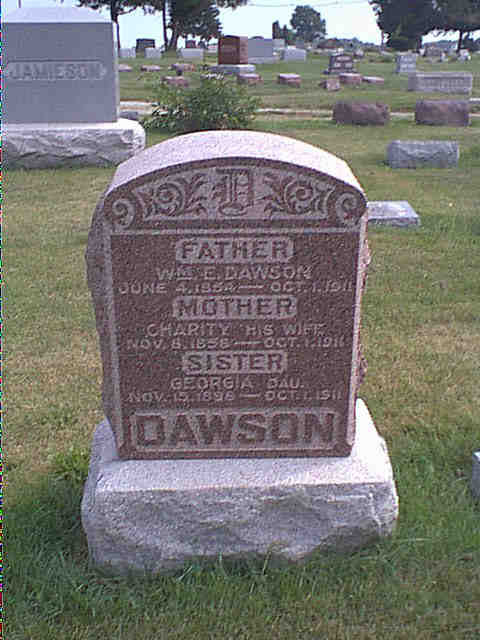
Questions about the Dawsons and the crime…
During the last year I have doing my best to track down more information about William Dawson and his family. I have come up with nothing I didn’t already know. You can read about that here. Instead of rehashing the
The photo above is the former location of the Dawson's house as seen through Google Maps. The blue line indicates the direction the killer went after the murders. To the north of the house is the section of the railroad tracks nearest the house. It’s approximately a half mile way. The portion of town south of those tracks was referred to by locals as the “colored section” of town, indicating a high concentration of black families. Now I don’t know what the ratio of black to white households in that part of town were in 1911 but it probably leaned heavily toward black since this was also where the brand new “colored church” was located (right across the street from the Dawson’s home in fact). The question I have is this; what are the odds a killer would pick, at random, one of the few white families in a heavily black community? Just something I think about…
The Monmouth crime has something in common with Villisca besides the obvious things. Both in Villisca and Monmouth the crime scenes were located quite a bit farther away from the railroad tracks then at the other crime scenes. In Colorado Springs, the tracks were just a half a block away; in Ellsworth they were almost in the front yard of the house and in Paola they were only a few houses away. If the killer was utilizing the railroad to make his escape then he needed to walk quite a ways through both Villisca and Monmouth before getting to the tracks where he likely escaped from town. Does this indicate the killer had some knowledge of at least those two towns?
If there are any descendants of William and Charity Dawson who are reading this post, I would be very interested in hearing from you.
Friday, September 23, 2011
User error or something...
Problems with Profiling …

Profiling is the double edged sword of criminal investigation. On the one hand it can be beneficial in building a strategy for interrogation and investigation of suspects but on the other hand it can create false leads and throw off investigations. John Douglas, one of the FBI detectives who helped create the discipline of criminal profiling, has stated that profiling is just one tool an investigator can use to apprehend a killer. It is through hard and tireless work of detectives that crimes are solved. Historic crime hobbyists, me included, often reach for modern concepts to gain insight into crimes of the past. This can be both fun and yield some new avenues of investigation. The problem comes when people watch TV shows like CSI and Criminal Minds which tend to portray psychological profilers as some kind of warlock looking through layers of time to see the murderer. Can modern profiling be useful in historic crimes? Yes but I think there are problems when context isn’t considered.

Context can be a major problem when profiling a historic crime. Robert Ressler offers a profile of the killer based on the Villisca crime scene in the excellent documentary Villisca: Living with a Mystery. In his opinion the killer was a “mixed typology.” Okay, Inspector, so what? You say the same thing. Well to answer my own hypothetical (and slightly schizophrenic) question I have to point out a couple of those elements which make the crime scene disorganized.
1) Weapon left at the crime scene
2) Lots of forensic evidence (fingerprints as far as I know) left at crime scene
First of all, you have to understand the difference between criminal investigation in 1911 and criminal investigation in the 1970’s (when these typologies were proposed). Aside from the awesome soundtrack of a 1970’s investigation, there also needs to be consideration for what tools were available to an investigator at the time. The organized killer plans out the crime in large part to conceal his/her involvement. By 1970 fingerprint, fiber and blood analysis were common ways a crime was investigated. By the time the typologies of Organized, Disorganized and Mixed entered into investigations (1992) forensics had advanced geometrically in ways that a serial killer in 1911 would never have imagined. An Organized offender today would take steps to ensure no finger prints, hairs or blood (or other body fluids) was left behind at the crime scene because these are all things which modern forensics can trace back to the killer.
In 1911 the organized offender didn’t have to worry about these things at all. Investigators could barely tell if blood found at the scene was human, let alone a blood type. Fingerprint analysis was in its very early stage and it had not been used to solve a crime in the
P.S. ~ The Halloween season is upon us. For those of you who found this place Googling “axe murder” or “serial killers,” welcome. Look around and leave a comment.
Wednesday, September 21, 2011
Victimology: May A. Burnham
Victimology is becoming a much more important area of study in the larger field of criminology. Most often a criminal is caught by tracking down points in time and locations at which the victim may have contacted the perpetrator. What were the victim’s habits or actions that might have led to this contact? Often times a victim who seems to be a low risk for violent crime is discovered to have engaged in high risk behaviors such as drug use or prostitution. Victimology is not without controversy. Victim’s advocates have argued this is a way of assigning partial responsibility for the criminal’s actions to the victim themselves (the old “[he, she] was asking for it” fallacy. In fact there is a term in sociology, penal couple, which assigns near equal blame to the victims of violent crimes. As an anthropologist I think this, along with a lot of sociology, is utter crap. But that’s for another day. For now let’s look at May Burnham.
Twenty-five year old May Alice Burnham was the oldest daughter of John and Emma Hill. John met Emma while working for the railroad making railroad ties and they were married about 1882. John’s job would require him to move his family on down the line as the rails were built. May and her younger sister Nettie would be born in
May would marry Arthur, then a recovering “lunger” around 1904. Arthur worked as a store clerk in various locations throughout
One thing to examine when putting together a victimology is the kind of behaviors a victim has that put them into contact with strangers. In order to make ends meet, May would take in “overflow” from Anna Merritt’s house when someone needed a bed for the night. This often involved renting the bed in one of the two rooms of the house. The door between these rooms had a lock on it and could be secured from one side although I admit I do not know which side it was. May also allowed borders to rent the hammock on the front porch of the house. This would have brought her into contact with strangers regularly and in the few weeks the