Showing posts with label Dawson. Show all posts

Thursday, October 13, 2011

Questions about the Dawsons and the crime…

During the last year I have doing my best to track down more information about William Dawson and his family. I have come up with nothing I didn’t already know. You can read about that here. Instead of rehashing the Dawson murders I would like to discuss something I’ve found interesting about the Monmouth crime; location, location, location.

The photo above is the former location of the Dawson's house as seen through Google Maps. The blue line indicates the direction the killer went after the murders. To the north of the house is the section of the railroad tracks nearest the house. It’s approximately a half mile way. The portion of town south of those tracks was referred to by locals as the “colored section” of town, indicating a high concentration of black families. Now I don’t know what the ratio of black to white households in that part of town were in 1911 but it probably leaned heavily toward black since this was also where the brand new “colored church” was located (right across the street from the Dawson’s home in fact). The question I have is this; what are the odds a killer would pick, at random, one of the few white families in a heavily black community? Just something I think about…

The Monmouth crime has something in common with Villisca besides the obvious things. Both in Villisca and Monmouth the crime scenes were located quite a bit farther away from the railroad tracks then at the other crime scenes. In Colorado Springs, the tracks were just a half a block away; in Ellsworth they were almost in the front yard of the house and in Paola they were only a few houses away. If the killer was utilizing the railroad to make his escape then he needed to walk quite a ways through both Villisca and Monmouth before getting to the tracks where he likely escaped from town. Does this indicate the killer had some knowledge of at least those two towns?

If there are any descendants of William and Charity Dawson who are reading this post, I would be very interested in hearing from you.

Tuesday, September 30, 2008

Remembering Monmouth Today...

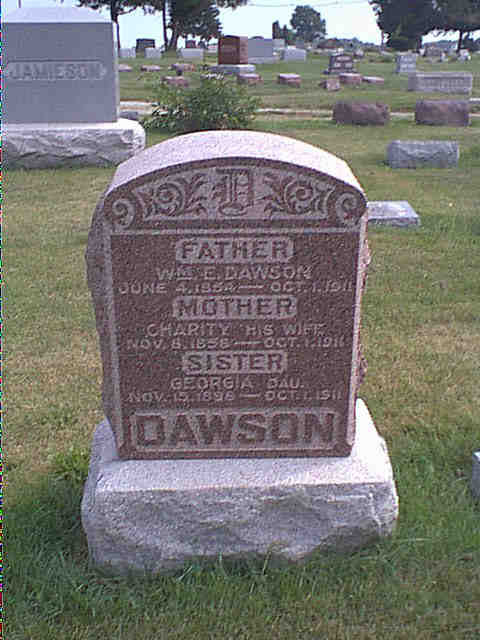
As the Coroner’s Jury in Colorado Springs was being released, nearly a thousand miles away William Dawson, caretaker of the 1st Presbyterian Church, diligently spent his paycheck paying bills at the kitchen table of his little five room cottage. The house was typical for the time. Originally a four-room cabin, a lean-to addition had been built on at some point in order to expand it. It was still a very small house for him, his wife Charity and his three daughters, Maud, Clarabel and Georgia; the youngest of William and Charity’s seven daughters. William had moved his family into the little house about eight years before, after having spent time in prison for horse theft. Clarabel and Maud had spent the day with friends and family outside of town and were going to stay the night with them as well. Georgia would be thirteen in a couple months and likely sat at the table with her father finishing up her schoolwork.

The Dawsons lived south of the railroad tracks that cut the little town of Monmouth, Illinois in half. It was the section of town referred to by locals as the “Colored” section and Dawson home was next door to the “Colored Church,” Cavalry Baptist. The congregation at Cavalry would eventually move into another building closer to the town square and that building is currently being torn down due to maintenance costs. I’ve already told the story of the discovery of the Dawson’s bodies on Oct. 1, 1911 so I won’t rehash it now but I can tell you the Dawson murders were the first to actually have a suspect arrested and put to a grand jury. Today we remember the victims, William, Charity and Georgia Dawson.  

Friday, May 30, 2008

So what happened at Monmouth…

As I’ve mentioned before finding information about the Monmouth murders is quite difficult. Resources are scarce, even newspaper reports. But through tenacious digging and pissing off more than a few state and county employees I have been able to put together a reasonable amount of data about the crime scene.

The Dawsons had lived in their home for about eight years (possibly six) and this was another small cottage. The house was located several blocks south of the railroad tracks and was in an area inhabited mostly by black families which meant, at that time, a very poor neighborhood. The descriptions of the layout of the house vary and some do not match up with the only known photograph of the crime scene (an exterior shot of the house with arrows pointing to the rooms in which the Dawson’s bodies were found). I know the house faced east and contained five rooms. There was a kitchen with a back door which lead into the living room in the middle of the house. On the north side of the house were two (or three) bedrooms. Directly across from the kitchen was the bedroom in which Georgia was found. Her parents were found in the bedroom next to hers. Across from the parent’s bedroom was the bedroom two other daughters shared although it is possible one of them shared the room in which Georgia was found. The bodies were covered by bed clothes and the windows were covered by curtains. The parents appeared to have been killed without waking up but Georgia was found differently. According to one source:

[Georgia] was found in her bed shoved down off the pillow and with one hand raised above her head as though she had attempted to pull the covers over her head when she saw harm coming.


A rumor ran through the crowd standing outside the crime scene that Georgia had been raped but I haven’t seen anything to corroborate this. Is it possible that Georgia was posed in much the same position as Lena Stillinger would be eight months later?

The weapon was not immediately located and was at first believed to have been a hammer. More than one report indicated the victims had been dispatched with a single blow. Bloodhounds followed the trail west out of town to a pond near the southbound railroad tracks. On the bank of the pond was found a two foot length of one-inch gas pipe covered in blood and hair. This was sent to Chicago for analysis and it was confirmed the blood and hair was human. There were bloody fingerprints on the weapon and these were supposedly photographed. No mention of evidence the killer washed up at the scene and there weren’t any “open” flame light sources found. Several months later the wire fence at the back of the property was being removed and a pocket flashlight was found. The flashlight is a key piece of evidence and deserves its own post. The fence was in the path of the alleged escape rout so it is very possible the flashlight was used to commit the crime then was dropped as the killer crawled through or over the fence. I have yet to find anything on how the killer gained entrance or from which point entrance occurred. I’ll put up my observations about the flashlight in my next post.

Wednesday, May 14, 2008

The Second Murder


Monmouth, Ill – On September 30, 1911, Assistant District Attorney for Colorado Springs, M. W. Purcell, abruptly and surprisingly adjourned the Coroner’s Inquest in the matter of the Burnham – Wayne murders. He had called just four witnesses. Three politicians, Sherriff Birdsall, Coroner Jackson and ADA Purcell, all tried to push blame away from themselves. The Sherriff decided to turn the case over to the Pinkertons, the Pinkertons didn’t want it because they saw little hope of getting paid and the superintendent of detectives for the Denver office declared the “fears of repetition of the slaughter were groundless.” If only that were so…

As the Not-Me game was being played in Colorado Springs, William and Charity Dawson and their not quite thirteen years-old daughter Georgia were sleeping soundly at their home in the little college town of Monmouth, Illinois. William was the janitor for the 1st Presbyterian Church and had to get up Sunday, October 1st in order to open the church up for the day’s services. William and Charity were from Indiana and married June 6, 1875. In all they had eleven children (four were not living at the time) three of which were living at home in their small, five-room cottage in the “colored district” of town. On this night, two of the daughters were staying with friends and family in other towns. William had moved his family to Monmouth eight years before after serving a stint in prison for horse stealing. By all accounts he was a reformed man and well liked by the town and the church he worked for. He had proven himself to be an honest, hard working man and that’s why the minister, Rev. C. J. Greene, was so puzzled on Sunday morning when the church was still locked. When Dawson still hadn’t shown by the start of eleven o’clock services, Rev. Greene became worried that Dawson might be seriously ill. Two parishioners went to his house after a phone call went unanswered. The front door was locked and repeated knocks received no response. On man went to the back of the house and knocked on the kitchen door with the same result. He tried the knob and the door swung open.

The house was dark. All the windows had been closed and the curtains pulled. The men made their way through the kitchen and the living room to the front (south) bedroom where they found the bloody body of Georgia Dawson. The police were notified and a crowd soon gathered around the house. William and Charity were found dead in their bedroom on the north side of the house. A white family had been slaughtered in an area of town known as the “colored district” and care had to be taken to control rumors in order to prevent a riot or lynching but this didn’t stop the rumors from flying.

The details surrounding this crime are hard to come by. Official documents relating to it seem to have vanished, including the summery of the Coroner’s jury, which is normally the only thing you can find from an inquest. Of all the crimes in the series, Monmouth to me is the most intriguing. The racial aspects of the case are just one facet. The seeming ingenuity of the killer is another and there are some tantalizing and somewhat confusing aspects to sift through. One of the first hypothesizes explored, indeed it was discussed on day two, was the idea a group of blacks had slaughtered the family because William Dawson paid too much attention to their female relatives. The police had given up on the case by 1913 but two years later, three lawyers “cracked it” and – surprise – the culprit was a black man and the motive was affections shown towards his female relatives. I’m going to spend some time on this one in the coming weeks so hunker down…